Category: City Council

  • Following the money in the May elections

    by Jim Scheppke 

    With just a couple weeks to go until the election, most of the money has been contributed and spent by all ten candidates for mayor and city council. So it’s a good time to see what that looks like. Fortunately we require all major candidates to post their contributions and expenses to the ORESTAR database run by the Oregon Secretary of State, so it’s not too difficult to see what has been going on.

    As of May 1st here is the big picture for our five Progressive candidates and the five conservative candidates supported by Marion+Polk First, a Republican-aligned group that has become a big player in both School Board and City Council elections in recent years.

    Not surprisingly, our candidates are being outspent by more than 2:1. That has always been true for Progressive Salem ever since we began a decade ago. That’s why our strategy has always been “organized people beat organized money,” and it’s nearly always worked for us. Here is how things look going down to the individual candidate level.

    Same story. Where it gets really interesting is when you look at where the money is coming from. Our candidates get a nice balance of small donations, medium-sized donations and large donations. 

    It’s quite a contrast when you look at donation sizes for the Marion+Polk First candidates.

    Only 4% of the money contributed to our opposition comes from small donors and a whopping 83% comes from over-$1,000 donors! They are donors like developer Larry Tokarski and his company ($57,000), our firefighters union ($14,500), the Oregon Realtors ($12,000) and retired auto dealer Dick Withnell ($10,639). The Marion+Polk First political action committee contributed $102,839 to their candidates, but $100,000 of that came from a shadowy new group called Businesses for Community who can launder their money by giving it to Marion+Polk First.

    Of course all this is possible because until now Oregon has had no campaign finance limits. That is supposed to change next year with some new limits passed by the Legislature. So let’s hope this might be the last year that we have to do battle with really big spenders!

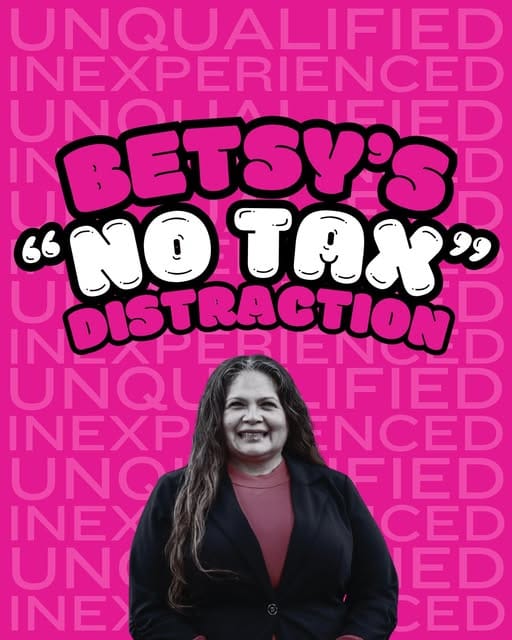
  • Betsy’s “no tax” distraction

    Betsy's no tax distraction

    Betsy Vega wants to represent Ward 6 on Salem City Council. She just needs you to ignore a few things first. Like the fact that 86% of her campaign funding comes from Marion-Polk First and the Oregon Realtors PAC. Not from Ward 6 neighbors. Not from East Salem families. From two outside money interests with their own very specific reasons for wanting a friendly vote on the council. When developers and real estate PACs are bankrolling 86 cents of every dollar you raise, you are not a community candidate.

    And what has Betsy chosen to lead with? A bold public stance on the Oregon gas tax referendum — a statewide ballot measure that a Salem city councilor has exactly zero power over. Salem City Council does not pass state law. Does not repeal state law. Has nothing to do with it. Betsy Vega has the same influence over this referendum as your neighbor’s golden retriever.

    Listen, it’s clear the gas tax referendum is doomed. But the funding Betsy is so loudly opposing? It flows back to municipalities like Salem for road maintenance. Betsy Vega is campaigning against money for Salem roads while running for the body that oversees Salem roads. The PACs that built her apparently forgot to brief her on that part. Ward 6 desperately needs road improvements.

    Now she’s going after Mai Vang for having a personal opinion on public transit funding too — specifically, for saying she personally supports mass transit and Cherriots while making clear that as a councilor she’d leave funding decisions to voters. But here’s the part Betsy really doesn’t want you to think too hard about: Salem City Council has no vote on any SAMTD payroll tax. Cherriots is an independent district. A Ward 6 councilor cannot impose it, block it, or control it in any way. Vega is attacking Mai Vang for a personal opinion on a tax that the seat she’s running for has zero jurisdiction over.

    Yes, the candidate who reads her answers is attacking her opponent for actual thoughts.

    Ward 6 has a clear choice: a candidate who was built by outside money, or a candidate who was built by this community. One of them knows what Ward 6 actually needs and what a city councilor actually does. Vote wisely.

  • The price of punishment

    Why Marion+Polk First’s “treatment first” approach is a bad deal for Salem

    Salem is facing real challenges. A strained budget, rising housing costs, and a homelessness crisis shaped by forces far beyond city limits. What Salem doesn’t need right now is a costly ideological experiment dressed up as tough love.

    Enter the Marion+Polk First slate. Their pitch is seductively simple to some: make treatment a condition of receiving shelter. Sounds reasonable until you ask a few obvious questions, like: treatment paid for by whom? Administered by whom? And what happens to people who can’t comply, won’t comply, or are in no condition to comply? The treatment-first model doesn’t actually answer those questions. It just implies that whatever happens next is the person’s own fault.

    That’s not a policy. That’s a shrug with a price tag attached. It’s classism with a clipboard.

    The treatment-first framework rests on a flattering assumption: that homelessness is primarily a behavioral problem, solved when individuals make better choices. This conveniently ignores that along with the rest of the country, Salem is experiencing a housing affordability crisis that is grinding working families into poverty. Rents are up. Wages aren’t. Medical debt is the leading cause of bankruptcy in America. People are one job loss, one illness, one bad month away from losing everything. Demanding they complete a treatment program before they’re allowed inside is punishing people for being poor in a system that manufactured their poverty.

    Here’s what the Marion+Polk First slate isn’t talking about: Salem already has programs that are producing results. The Homeless Services Team (HST) pairs law enforcement with behavioral health outreach workers, connecting people to services without criminalization. The REACH Team does direct street outreach, meeting people where they are. These are not feel-good experiments. They’re evidence-based approaches that reduce street homelessness, build trust, and move people toward stability. Now the Marion+Polk First slate wants to torch the philosophy behind them in favor of a punitive gatekeeper model.

    Someone is going to need to explain, slowly and with citations, what problem they are actually solving.

    Salem has faced significant budget shortfalls. Against that backdrop, the Marion+Polk First candidates are proposing… a sprawling, mandate-heavy system that would require the City to assess, route, monitor, and enforce treatment compliance for an entire population of unhoused residents — many of whom have serious, chronic conditions that don’t resolve on a municipal timeline or a campaign promise. All while the Salem Police Department is understaffed, city staff are stretched thin, and the budget is only starting its recovery.

    Who’s paying for the treatment capacity? Who’s funding the compliance infrastructure? What happens when someone is discharged from treatment and has nowhere to go, again? These are not gotcha questions. They are the bare minimum a responsible city council candidate should be able to answer before asking Salem to blow up what is actually working. The Marion+Polk First slate does not have answers. They have vibes.

    Treatment-first policies have a long political history, and it is not a flattering one. They emerged as a way to appear compassionate while maintaining the ability to exclude, punish, and disappear people experiencing homelessness from public view. The “treatment” framing softens what is functionally a punishment model: comply or lose access to shelter, which in an Oregon winter, is not an abstract consequence. It is a potentially fatal one.

    Salem deserves candidates who understand that housing is the intervention. That stability enables recovery. That punishing people for the failures of an economic system they didn’t design isn’t tough love — it’s just expensive cruelty with better branding.

    The Marion+Polk First slate is offering Salem a more costly, less effective, and considerably crueler approach. They are asking voters to pay more for worse outcomes, dressed up in the language of accountability. We can do better.
  • April 7: Join Progressive Salem for First Tuesday

    First Tuesday at Taproot will include special guests Mai Vang, candidate for City Council, Ward 6, and David Inbody, candidate in Ward 4.  Please join us for a time of fellowship and good fun along with good food and beverages. 

    Hope to see you there.

    Taproot Lounge and Cafe
    356 State Street, Salem
    4:30 to 6:30
    Tuesday, April 7

  • April 12: Meet the candidates for Salem mayor

    MARK YOUR CALENDAR! Plan to come to the first-ever all ages mayoral forum at the Salem Public Library on Sunday, April 12th at 2 pm. Bring the whole family! Send in a question using the QR code below.

    Meet the candidates
  • Join Progressive Salem for First Tuesday; meet Vanessa Nordyke and Micki Varney

    Vanessa Nordyke
    Micki Varney for City Council

    Taproot Lounge and Cafe
    356 State Street, Salem
    Tuesday, March 3, 4:30 to 6:30

    Special guests:

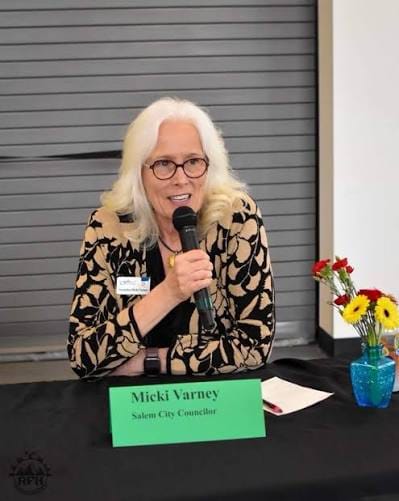
    Micki Varney, candidate for city council

    and Vanessa Nordyke, candidate for mayor

    Join like-minded progressive friends and meet Micki and Vanessa in a small group setting

  • Please Join Us for Canvassing Every Weekend Until May

    Canvassing for Progressive Salem

    This is how we win — by knocking on doors and talking to friendly voters who vote Progressive. We’ll be doing it every Saturday and Sunday until the election in May.

    On Saturdays at 10 am
    Meet at the Marion County Democrats Headquarters
    245 High St. NE Across from the Transit Mall
    We canvass for Vanesa Nordkye for Mayor and for Linda Nishioka, Mai Vang, and Micki Varney for City Council

    On Sundays at 1 pm
    Canvass for Dave Inbody in Ward 4

    If you are new to canvassing we can pair you up with an experienced canvasser. Please join us!

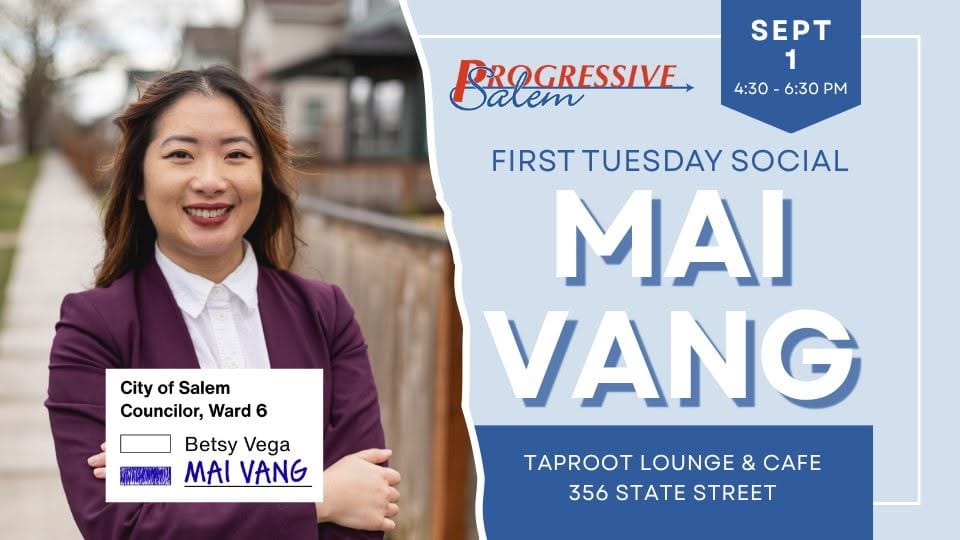
  • Progressive Salem Supports Mai Vang’s Re-election in Ward 6

    By Kathleen Trepa

    Elect Mai Vang in Ward 6

    Mai Vang was elected to Ward 6 in the May 2025 special election and is running for re-election for a full term.

    A Willamette University Law School graduate and daughter of Vietnam War refugees, Mai brings a strong sense of family, cultural diversity, the value of community and the belief in the American dream to Ward 6 and the City Council. Mai has already shown she leads with her heart and values. 

    Mai’s primary goals are to focus on transportation improvements, including traffic calming, pedestrian safety, and access to bus routes and bike lanes. She is committed to improving 911 response times in Ward 6. She supports the construction of the previously approved local Fire Station and funding the necessary police and fire resources to effectively serve Ward 6. She also champions the Community Violence Reduction Initiative. 

    Housing affordability is a critical issue in East Salem, which is home to many minority and lower income neighborhoods. Mai’s dedication to supporting renter protections and rights is driven by her personal experience as a renter; she will propose a city task force of property owners and renters to explore options to protect affordable rental housing.

    Helping people keep their homes is a more cost-effective and humane strategy than only funding intervention efforts once people become unhoused. As a result, she supports the re-establishment of the City’s Social Services Advisory Board with an annual $400,000 budget. Fifteen percent of Salem’s population lives below the Marion County poverty line, and the bi-annual Point In Time homeless count shows that the majority of Salem’s unhoused are from Salem. Mai believes the City should and can do more to help keep her neighbors housed. 

    Join Progressive Salem in supporting Mai’s re-election campaign. To learn more, please visit electmaivang.com.

  • Join Progressive Salem for First Tuesday, February 3

    Taproot Lounge and Café

    356 State Street, Salem

    4:30 to 6:30

    David Inbody, candidate for Salem City Council, Ward 4

    David Inbody, will be our special guest.  David is running for election to represent Ward 4 in May.  Ward 4 includes most of Salem south of Kuebler.  This seat is currently held by Deanna Gwyn, a Republican and real estate agent, with a narrow perspective. 

    Meet David, learn about his background and what he can bring to Salem, and how you might help with his campaign.